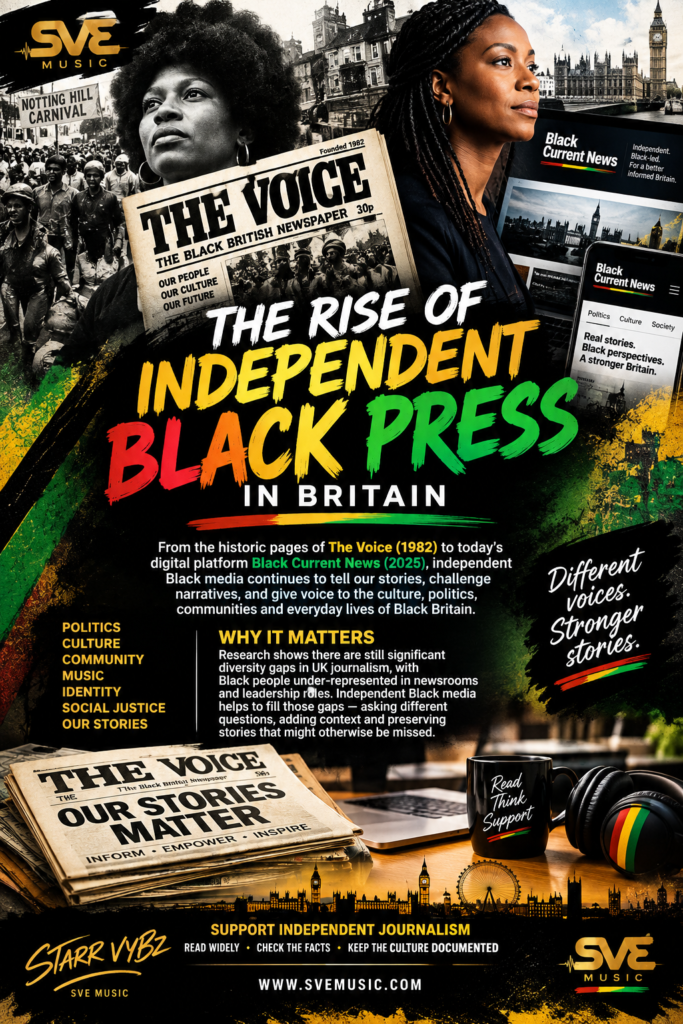
THE RISE OF INDEPENDENT BLACK PRESS IN BRITAIN
SVE MUSIC
Who tells the story matters.
For generations, Black communities in Britain have created their own media because they wanted news, culture and public affairs covered from perspectives that reflected their own experiences.
One of the most important milestones was The Voice, launched in London in 1982 by Jamaican-born Val McCalla. The London Museum records that it was aimed at young Black people born and brought up in Britain, achieved a large circulation and campaigned against discriminatory laws affecting Black Londoners. It also became an important platform for reporting on community affairs, politics and culture.
More than four decades later, that tradition has entered a new digital era.
Black Current News, founded by award-winning journalist Nadine White, describes itself as an independent news platform covering the politics, culture and social issues shaping Black life in Britain. The publication says its purpose is to report with rigour, add context where it is missing and document stories affecting Black Britain for future generations.
Black Current News officially introduced itself to readers in October 2025, describing its journalism as putting Black perspectives at the centre and covering stories that mainstream outlets can under-report or miss.
WHY DOES THIS MATTER?
There is evidence that Britain’s journalism industry still has significant diversity problems.
A 2025 Reuters Institute study based on a representative survey of 1,130 UK journalists found that 90% of journalists surveyed were White, while 91% were university educated.
Separate 2025 Reuters Institute research examining major news outlets found that none of the UK outlets in its sample had a person of colour as their top editor at the time of the study.
These figures do not prove that mainstream journalism cannot report Black stories.
But they do highlight an important question:
Who has the power to decide which stories are commissioned, which voices are prioritised, what context is included and what becomes part of the historical record?
That is where independent Black media can play an important role.
From The Voice in the 1980s to digital-first platforms such as Black Current News, Black British journalism has continued to create spaces where politics, racism, culture, music, community, identity and everyday life can be reported with Black British experiences at the centre.
And independent journalism should not be given a free pass simply because it is independent.
Facts still matter. Evidence matters. Accuracy matters. Accountability matters.
The strength of independent Black media is not that it should tell people what to think.
It is that it can ask different questions, preserve different perspectives and make sure stories that might otherwise receive limited attention are documented and investigated.
🖤 THE SVE MUSIC VIEW
The Black press is part of the wider Black British cultural archive.
From newspapers and radio to reggae magazines, music journalism, websites, podcasts and social media, independent platforms have helped document the people, movements, music and communities that have shaped Britain.
The story of Black Britain should not disappear because nobody thought it was important enough to record.
Support independent journalism.
Read widely.
Check the facts.
Challenge misinformation.
And most importantly — keep the culture documented.