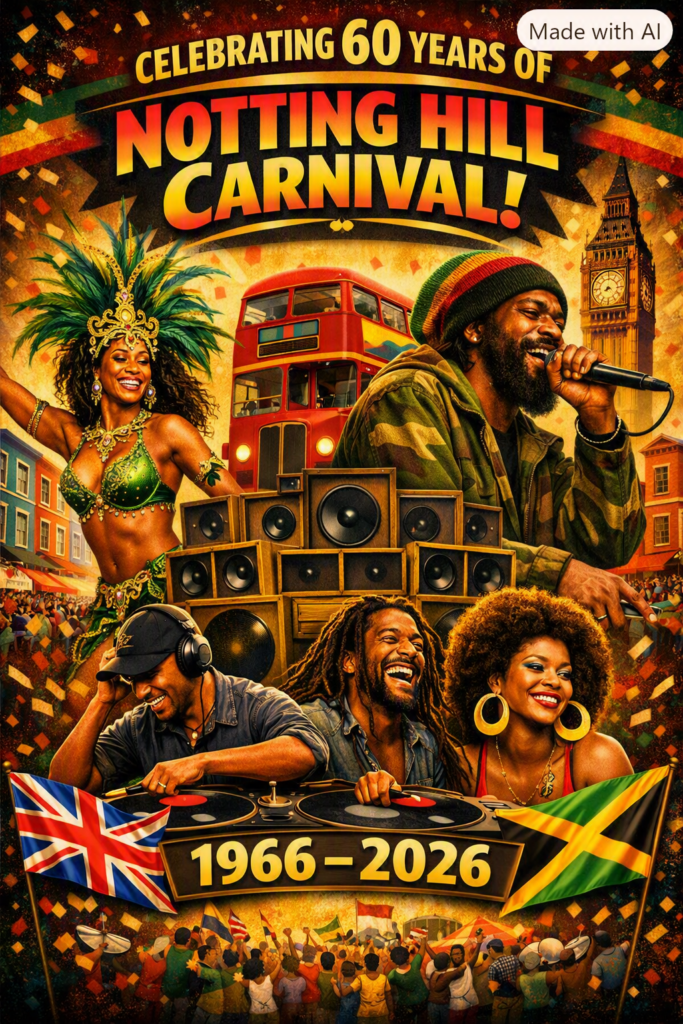
60 YEARS OF NOTTING HILL CARNIVAL: THE REGGAE, SOUND SYSTEM & CULTURE THAT CHANGED BRITAIN
By SVE Music | August 2026
For six decades, the streets of West London have been transformed by music, colour, culture and community.
In 2026, Notting Hill Carnival celebrates its 60th anniversary — a remarkable milestone for one of Europe’s biggest and most recognisable street festivals.
But behind the costumes, dancing and huge crowds lies another story.
The story of reggae.
From Jamaican sound systems and dub to lovers rock and dancehall, Caribbean music has been at the heart of Notting Hill Carnival’s identity for generations.
🇯🇲 WHERE REGGAE MEETS LONDON
Notting Hill Carnival emerged from the Caribbean communities that had established themselves in West London, particularly around Notting Hill and Ladbroke Grove.
The first Carnival took place in 1966, organised by community activist Rhaune Laslett.
It was initially conceived as a multicultural community celebration, but Caribbean culture quickly became central to the event.
Music was always going to be crucial.
And the Jamaican sound-system tradition provided the perfect soundtrack.
Sound systems brought something different to the streets of London.
Huge speakers.
Deep bass.
Dub plates.
Selectors.
MCs.
And a musical culture where the crowd wasn’t simply watching the entertainment — the crowd was part of it.
🔊 THE SOUND SYSTEMS TAKE OVER
During the 1970s, sound systems became increasingly important to Carnival.
Jamaican music was evolving rapidly.
Roots reggae was giving way to dub experimentation, while new forms of dancehall and reggae were emerging.
London’s Caribbean communities embraced the music and made it their own.
Sound systems became mobile cultural hubs, bringing Jamaican records directly into the streets.
Among the names associated with the Carnival’s musical history are legendary British and Caribbean sound systems such as Jah Shaka, Saxon Sound, Channel One, Aba Shanti-I and Sir Lloyd.
Each generation brought something different.
But the principle remained the same:
BIG SOUND. BIG BASS. BIG CULTURE.
🎛️ DUB CHANGED THE SOUND OF CARNIVAL
One of the most important contributions came through dub.
Dub stripped reggae back to its essential ingredients — bass, drums, echo, reverb and space — and turned the recording studio into another musical instrument.
British-based producers and engineers embraced the possibilities.
Among the most influential was Mad Professor, whose Ariwa Sounds operation became an important part of London’s reggae and dub history.
From his studio in South London, Mad Professor worked with Jamaican legends and British artists, helping create a distinctly London interpretation of dub.
The connection between Jamaica and London became increasingly powerful.
Music travelled in both directions.
❤️ LOVERS ROCK — LONDON’S OWN REGGAE SOUND
Notting Hill Carnival also became closely associated with lovers rock.
While roots reggae remained hugely influential, London’s Caribbean communities developed their own romantic, soulful interpretation of reggae.
Artists including Janet Kay, Carroll Thompson, Dennis Bovell, Maxi Priest and others helped establish lovers rock as a major British reggae movement.
The music was different from the militant roots sounds that dominated some Jamaican productions.
It was romantic.
Soulful.
Melodic.
And unmistakably British.
Carnival provided one of the places where these different strands of reggae could meet.
🇬🇧 FROM REGGAE TO DANCEHALL
As the decades passed, the Carnival soundtrack continued to evolve.
Roots reggae was joined by:
Dub.
Lovers rock.
Dancehall.
Soca.
Afrobeats.
Grime.
UK garage.
But reggae and sound-system culture remained part of the foundation.
This ability to evolve is one of the reasons Notting Hill Carnival has remained culturally relevant for 60 years.
The music changes.
The technology changes.
The generations change.
The sound-system spirit remains.
🔥 NOTTING HILL CARNIVAL & BLACK BRITISH CULTURE
The importance of Carnival goes beyond music.
For generations of Black Britons and Caribbean communities, Notting Hill became a place where culture could be expressed publicly and proudly.
Jamaican, Trinidadian, Vincentian, Grenadian and other Caribbean traditions came together with the growing Black British experience.
Reggae played a major role in that cultural expression.
It provided a soundtrack for identity, resistance, celebration, love and community.
And importantly, the influence didn’t remain inside Carnival.
The sound-system culture surrounding Notting Hill helped influence generations of British musicians and producers.
From reggae and lovers rock to jungle, drum & bass, garage and grime, the bass-heavy DNA can still be heard throughout British music.
🎚️ 60 YEARS LATER — THE SOUND IS STILL ALIVE
Six decades after the first Carnival, the technology may have changed dramatically.
But walk through the streets during Carnival and the fundamental experience remains familiar.
A sound system sets up.
The speakers go up.
The selector chooses the next tune.
The bass rolls through the streets.
People gather.
And suddenly the music becomes a shared experience.
That is the magic of sound-system culture.
It isn’t simply about listening to music.
It’s about experiencing music together.
🇯🇲 JAMAICA TO LONDON — AND BACK AGAIN
One of the most beautiful aspects of the Notting Hill story is the relationship between Jamaica and Britain.
Jamaican music influenced London.
London then developed its own reggae culture.
British reggae artists and producers subsequently influenced Jamaica and the wider world.
That musical conversation has continued for generations.
From Bob Marley and Dennis Brown being heard across British streets to Steel Pulse, Aswad, UB40, Janet Kay, Linton Kwesi Johnson, Mad Professor and countless others, reggae became part of Britain’s musical landscape.
Notting Hill Carnival was one of the places where that relationship could be heard loudest.
🎉 SIXTY YEARS — AND STILL MOVING
Notting Hill Carnival reaching its 60th anniversary is more than a celebration of a festival.
It is a celebration of community, migration, music and cultural survival.
And reggae deserves its place at the centre of that story.
The Jamaican sound-system tradition helped transform how people experienced music in Britain.
It helped establish the idea that the street could become a dancefloor.
It gave young people a space to express themselves.
And it helped lay foundations for some of Britain’s most influential musical movements.
🇬🇧 SVE MUSIC — OUR TAKE
60 years of Notting Hill Carnival is 60 years of Caribbean culture leaving its mark on Britain.
And when we talk about that history, we cannot leave reggae and sound-system culture out of the conversation.
From the early sound systems to today’s massive Carnival stages, the connection between Jamaica, London and reggae music remains incredibly strong.
The names may change.
The riddims may change.
The speakers may get bigger.
The technology may become more sophisticated.
But the heartbeat remains the same.
🔊 ONE LOVE. ONE COMMUNITY. ONE SOUND.
🇯🇲💚💛❤️ HAPPY 60TH ANNIVERSARY, NOTTING HILL CARNIVAL!
SVE MUSIC — UK REGGAE & DANCEHALL