By SVE Music
When music historians discuss the most important recordings in Jamaican music, one riddim is mentioned more than any other: Sleng Teng.
Released in 1985, the Sleng Teng riddim didn’t just produce a hit song—it revolutionised Dancehall, transformed music production, and helped launch the digital era of Jamaican music. More than four decades later, its influence can still be heard in reggae, dancehall, hip-hop, Afrobeats, and electronic music.
Before Sleng Teng
During the 1970s and early 1980s, Jamaican music was dominated by live bands. Producers relied on musicians to record basslines, drums, keyboards, and guitars in the studio. Legendary bands such as The Roots Radics, The Revolutionaries, and The Aggrovators provided the backing for countless reggae and dancehall classics.
Although synthesisers and drum machines had begun appearing in international pop music, live instrumentation remained the standard in Jamaica.
That was about to change.
An Accidental Discovery
The story of the Sleng Teng riddim has become part of Jamaican music folklore.
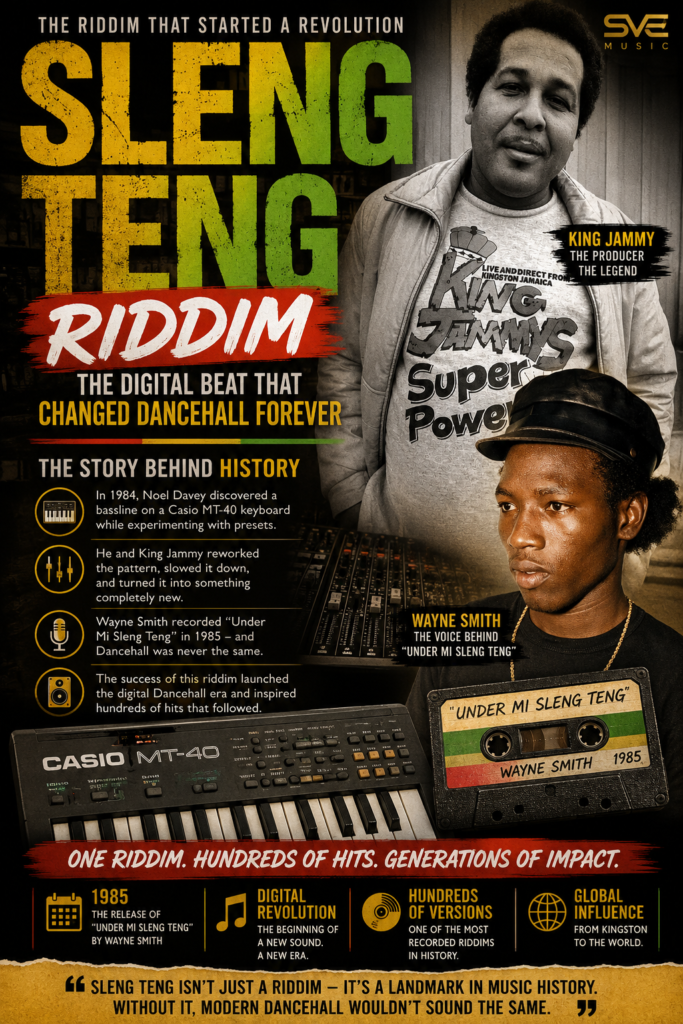
In late 1984, Noel Davey, a friend of producer King Jammy, was experimenting with a Casio MT-40 home keyboard. While exploring the keyboard’s preset accompaniment patterns, he discovered an unusual bass-and-rhythm pattern under the keyboard’s “Rock” setting.
Instead of dismissing it as a novelty, Davey and King Jammy recognised its potential. They slowed the rhythm, emphasised the bass, and transformed the preset into something completely new.
Few could have predicted that a small consumer keyboard would help reshape an entire genre.
Wayne Smith Makes History
King Jammy invited singer Wayne Smith to record over the new rhythm.
The result was “Under Mi Sleng Teng.”
Released in 1985, the song became an instant sensation. Dancehall audiences had never heard anything quite like it. The bassline was sharper, the rhythm was cleaner, and the overall sound felt futuristic compared with traditional live-band recordings.
The record quickly dominated Jamaican dances and radio stations.
The Beginning of Digital Dancehall
The success of “Under Mi Sleng Teng” marked the beginning of what became known as digital dancehall.
Instead of relying entirely on live musicians, producers increasingly embraced keyboards, drum machines, samplers, and digital production techniques.
This shift dramatically reduced recording costs while allowing producers to create riddims faster than ever before.
Within months, studios across Jamaica were producing digital rhythms inspired by Sleng Teng.
One Riddim, Hundreds of Songs
Like many classic Jamaican riddims, Sleng Teng became the foundation for numerous recordings.
Over the years, hundreds of artists have voiced the riddim, making it one of the most versioned instrumentals in Dancehall history.
Its influence can be heard across generations, from the pioneers of the 1980s to contemporary Dancehall performers.
King Jammy’s Defining Moment
Although King Jammy had already built a strong reputation as an engineer and producer—having worked closely with dub pioneer King Tubby—Sleng Teng elevated him to legendary status.
The riddim helped establish his studio as one of Jamaica’s most influential production houses during the mid-to-late 1980s.
Many of Dancehall’s biggest artists would later record for King Jammy, helping define the sound of an entire era.
A Global Influence
The impact of Sleng Teng extended far beyond Jamaica.
Its minimalist digital sound influenced:
- UK Dancehall
- Jungle
- Drum & Bass
- Hip-Hop producers
- Electronic music
- Afrobeats production techniques
The riddim also demonstrated that groundbreaking music could emerge from inexpensive equipment when combined with creativity and vision.
Did Casio Intend to Create Dancehall?
One of the most fascinating aspects of the Sleng Teng story is that Casio did not design the MT-40 keyboard specifically for reggae or dancehall music.
The keyboard’s preset rhythm was created as a generic accompaniment feature for home users. Jamaican producers creatively reimagined it, proving that innovation often comes from experimentation rather than intention.
Why Sleng Teng Still Matters
More than 40 years after its release, Sleng Teng remains one of the most influential riddims ever produced.
It changed how producers approached recording, accelerated the rise of digital music in Jamaica, and inspired countless artists around the world.
Without Sleng Teng, modern Dancehall might sound very different.
For many fans and historians, it represents the moment when Dancehall entered a new era—one driven by technology, creativity, and fearless innovation.
Sleng Teng Timeline
1984 – Noel Davey discovers the Casio MT-40 preset while experimenting with the keyboard.
1985 – King Jammy produces Wayne Smith’s “Under Mi Sleng Teng.”
1985 – The song becomes a massive hit in Jamaica and sparks the digital Dancehall revolution.
1985–1986 – Producers across Jamaica begin creating digital riddims inspired by Sleng Teng.
Today – Sleng Teng is recognised as one of the most influential riddims in the history of Jamaican music.