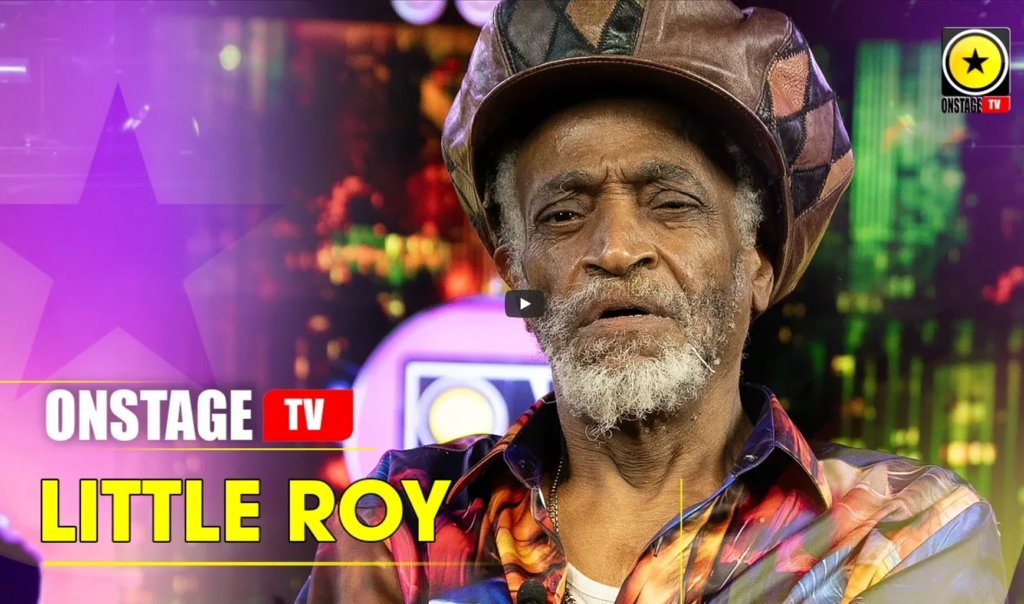
An editorial exploration of a pioneer whose influence runs deeper than his fame
In the story of Jamaican music, certain names rise to mythic status. They become symbols — shorthand for eras, movements, and cultural revolutions. But beneath those towering figures lies a network of innovators whose contributions were just as vital, even if history didn’t place them on the biggest stages. Little Roy is one of those innovators: a quiet visionary whose early work helped define the spiritual and sonic DNA of reggae.
A recent feature on Onstage TV reintroduces him to the public eye, offering a timely reminder that reggae’s foundation was built by many hands — some celebrated, others overlooked. And Little Roy’s story is one that deserves far more attention than it has received.
A Youth in the Birthplace of a Movement
Born Earl Lowe in 1953, Little Roy grew up in the heart of Kingston during one of the most transformative periods in Jamaican music. The island was shifting from ska to rocksteady, and then into the early pulse of reggae — a sound still finding its identity. Many of the genre’s pioneers were barely out of their teens, and Little Roy was no exception.
He recorded his first tracks at an age when most youths were still figuring out who they wanted to be. But Roy already had a voice — not just vocally, but spiritually and politically. His early songs carried the unmistakable imprint of Rastafari, social awareness, and a deep sense of cultural responsibility.
This was the late 1960s: a time of political tension, spiritual awakening, and artistic experimentation. And Little Roy was right there in the middle of it, shaping the sound as it emerged.
The Sound of Early Consciousness
While many early reggae hits leaned toward romance or dancehall energy, Little Roy’s music took a different path. His songs were meditative, prophetic, and rooted in the struggles of the people. Tracks like:
- “Bongo Nyah” — a spiritual anthem that captured the heartbeat of Rastafari
- “Prophecy” — a politically charged reflection on Jamaica’s social climate
- “Tribal War” — a timeless commentary on conflict and unity
These weren’t just songs; they were early blueprints for what would become roots reggae — the genre’s most spiritually potent and globally influential branch.
Little Roy’s voice wasn’t loud or aggressive. It was calm, steady, and deeply assured. That quiet conviction became his signature, setting him apart from the more fiery vocalists of the era.
A Career That Survived Shifts, Storms, and Silence
Like many early reggae artists, Little Roy’s career didn’t follow a straight line. The 1970s brought political violence, shifting musical tastes, and an industry that often failed to preserve its own history. Many artists who helped build the foundation were overshadowed as reggae exploded internationally.
But Little Roy never disappeared. He migrated to the UK, where he continued recording, performing, and influencing new generations of musicians. His 2011 album “Battle for Seattle”, a reggae reinterpretation of Nirvana songs, surprised critics and introduced him to a new audience — proof that his creativity never dulled.
Still, despite decades of work, his name rarely appears in mainstream reggae conversations. And that’s precisely why features like the Onstage TV segment matter.
Onstage TV’s Tribute: A Reminder of Forgotten Greatness
The Onstage TV clip is brief, but its impact is meaningful. It positions Little Roy as a “founding reggae pioneer you might not know,” which is both accurate and revealing. It speaks to a larger truth about Jamaican music: many of its architects remain hidden in the shadows of history.
The segment doesn’t attempt to tell his full story — no short video could. Instead, it opens the door. It invites viewers to rediscover an artist whose work helped shape the consciousness of reggae long before the world knew what reggae would become.
Why Little Roy’s Legacy Matters More Than Ever
In today’s global music landscape — where reggae influences Afrobeats, hip-hop, trap, pop, and even electronic music — understanding the genre’s roots is more important than ever. Little Roy represents:
1. The Spiritual Core of Reggae
His music embodies the meditative, message-driven essence that defined the roots era.
2. The Political Voice of the People
Long before reggae became a global symbol of resistance, Little Roy was singing about injustice, unity, and social change.
3. The Resilience of Jamaican Artists
His career survived industry shifts, migration, and decades of under-recognition — yet his artistry never wavered.
4. The Importance of Preserving Musical Heritage
Artists like Little Roy remind us that reggae’s history is bigger than its biggest stars. It’s a tapestry woven by many hands.
The Call to Revisit, Relearn, and Revalue
Little Roy’s story is not just about music — it’s about memory. It’s about the artists who helped build a cultural movement but never received the spotlight they deserved. It’s about the responsibility we have, as listeners and as custodians of culture, to honour the full spectrum of reggae’s history.
The Onstage TV feature is a spark. The real work begins when we dive into his catalogue, share his music, and speak his name alongside the giants.
Because Little Roy wasn’t just part of reggae’s early years — he helped define them. And his legacy deserves to be heard, studied, and celebrated.