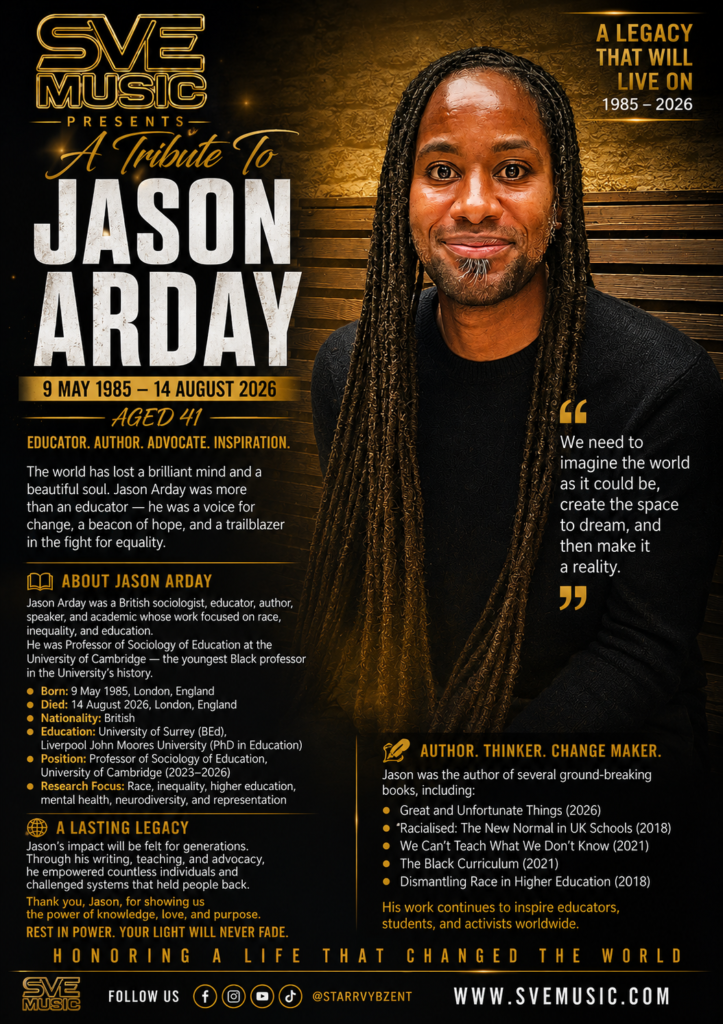
Published by SVE Music
Remembering the Man Behind the Headlines
The death of Professor Jason Arday at the age of 41 has left a remarkable and complicated story behind.
Arday became one of the most recognisable Black academics in Britain, rising from a difficult childhood in South London to the highest levels of British academia. In 2023, he made history when he was appointed Professor of Sociology of Education at the University of Cambridge, becoming the youngest Black academic ever to hold a professorship at Cambridge.
His story attracted attention far beyond the university world. He spoke openly about neurodiversity, education, racial inequality and the barriers faced by Black students and academics. His research and public work sought to challenge institutions and encourage greater inclusion.
Today, however, his legacy is being examined through both his considerable academic contribution and the serious questions that emerged during the final months of his life.
For a tribute to be meaningful, it must acknowledge both.
From South London to Cambridge
Jason Arday was born in London in 1985 to Ghanaian parents and grew up in South London.
His childhood story was central to the public profile he built. University and publisher biographies described him as having been diagnosed with autism and develop mental delays at the age of three, experiencing significant difficulties with speech and learning during childhood. His published biography states that he was non-verbal as a child and did not learn to read and write until around the age of 18.
His mother, Giff, played a particularly important role in the story he told about his development, using music, culture, faith and other creative approaches to help him communicate and learn. His memoir, Great and Unfortunate Things, was built around that journey and the determination of his family to reject the limits others had placed upon him.
Whatever questions have subsequently surrounded elements of his biography, there is no dispute that Arday eventually achieved a remarkable academic career.
He studied Education and Physical Education at the University of Surrey before completing postgraduate study and a PhD in Education at Liverpool John Moores University.
His first professorial appointment came at the University of Glasgow in 2021, where he became Professor of Sociology of Education. He had previously held an Associate Professorship at Durham University.
Then came Cambridge.
Making History at Cambridge
In March 2023, Arday took up his Cambridge professorship.
The University of Cambridge described his appointment as historic, identifying him as the youngest Black person ever appointed to a professorship at the university. He was 37 at the time.
His academic interests included race and higher education, intersectionality, mental health and education, neurodiversity and cultural studies. He also worked on issues surrounding racial inequality, representation and the experiences of Black students and staff within higher education.
He became involved with organisations including the Runnymede Trust and the British Sociological Association and served on advisory groups concerned with race equality, health and culture. He was also a Fellow of the Royal Society of Arts.
His influence extended beyond academia. He appeared in public discussions about race, education and equality and contributed to national conversations about Britain’s education system.
A Scholar of Race and Inequality
Arday’s published work was focused heavily on questions of inequality.
Among his academic publications were research examining the experiences of Black students and academic staff, racial inequality in higher education, mental health, precarious employment and decolonising the curriculum.
He was also an editor of Dismantling Race in Higher Education: Racism, Whiteness and Decolonising the Academy, published by Palgrave. The book brought together scholarship examining structural racism and inequality within British higher education.
His work was therefore not simply about personal advancement.
It was about changing the institutions through which people gain knowledge, qualifications and opportunity.
That is an important part of his legacy.
The Book That Became Part of the Story
In August 2026, shortly before his death, Arday’s memoir Great and Unfortunate Things was published in the United States by 37 Ink, an imprint of Simon & Schuster. The UK edition was scheduled for publication later in August.
The book tells the story of his childhood, his relationship with his mother and his extraordinary journey into academia.
Its publication became particularly poignant following the controversy that surrounded him.
The Controversy and the Need for Accuracy
In 2026, allegations emerged concerning plagiarism in parts of Arday’s 2015 doctoral thesis and questions were also raised about various claims concerning his career and personal history.
Arday denied deliberately plagiarising material and challenged the way he was being portrayed.
Cambridge initially defended him, but after what the university described as new information, it announced an investigation into the circumstances surrounding his appointment and his time at the university.
Liverpool John Moores University, where he completed his PhD, had previously reviewed questions surrounding his doctorate and maintained his PhD, although the wider controversy generated further scrutiny.
A number of other claims associated with Arday’s public biography have also been challenged by journalists, including claims concerning sporting achievements, fundraising and certain professional affiliations. Some claims have been disputed rather than definitively established as fabricated, so they should not be repeated as fact without qualification.
That distinction matters.
A tribute should not rewrite history — but neither should a person’s entire life be reduced to the controversy surrounding its final chapter.
His Final Days
Arday resigned from his Cambridge position in August 2026 as scrutiny surrounding his academic record and biography intensified.
On 14 August 2026, he was found unresponsive at a property in Battersea, south London. He was 41.
The Metropolitan Police said the death was unexpected but was not believed to be suspicious, with the circumstances being investigated and a file to be prepared for the coroner.
His family subsequently issued a statement expressing their devastation and saying that Arday had experienced sustained abuse, harassment and misinformation.
Cambridge also expressed its condolences, while public figures and academics paid tribute to him and called for reflection on the circumstances surrounding his final months.
At the time of writing, it would therefore be irresponsible to claim a definitive cause of death when the official process has not established one.
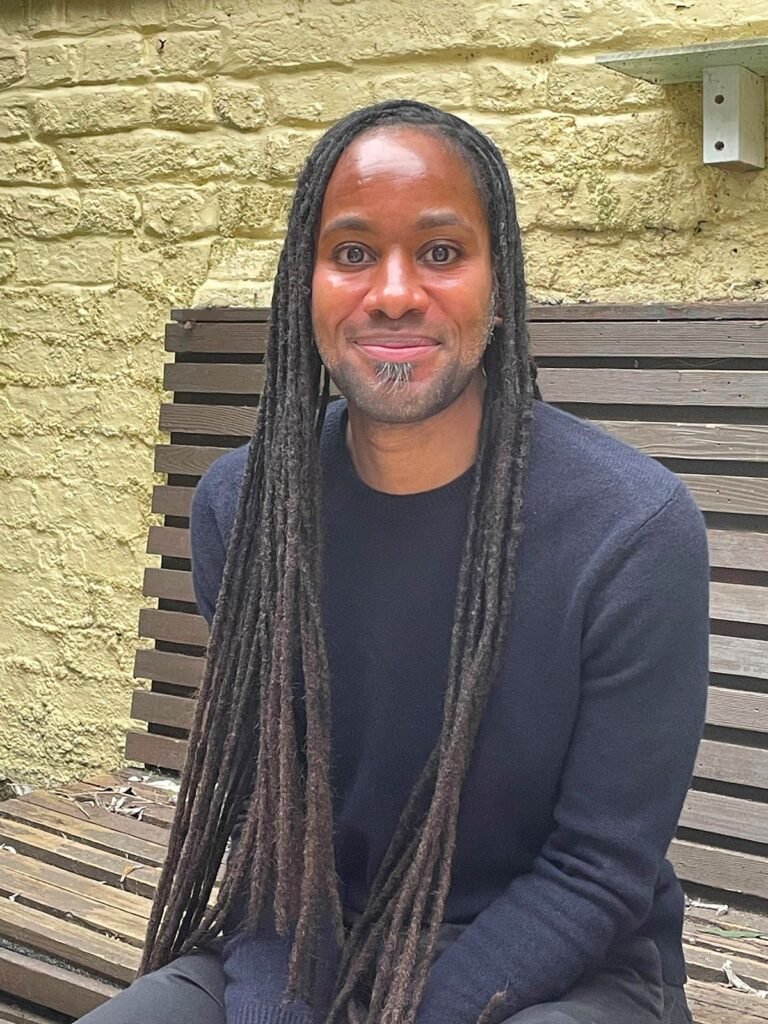
Remembering Jason Arday
Jason Arday’s story cannot be reduced to one sentence.
He was a son, partner, father, brother, academic, writer, public speaker and campaigner.
He became a symbol of possibility for people who had been told that certain doors were not meant for them.
He challenged the idea that Britain’s universities should remain places where particular communities were under-represented. He wrote about race and inequality. He spoke about neurodiversity. He encouraged young people to believe that education could transform their lives.
His story also reminds us of something uncomfortable but important: public figures are human beings, institutions have a responsibility to scrutinise credentials carefully, journalists have a responsibility to investigate fairly, and society has a responsibility not to turn complicated human beings into symbols.
Jason Arday’s achievements should be examined honestly.
So should the questions surrounding them.
But honesty does not require cruelty.
And accountability does not require dehumanisation.
A Legacy That Will Continue to Be Discussed
Jason Arday’s academic work will remain part of the record.
His research, books, lectures and advocacy contributed to Britain’s continuing conversation about race, education, inequality and representation.
His journey from South London to Cambridge demonstrated extraordinary ambition and determination. His final years, meanwhile, have raised difficult questions about academic standards, institutional responsibility, media scrutiny and the pressures placed upon people who become symbols of much larger cultural debates.
Perhaps the most respectful tribute is therefore not to present a perfect version of Jason Arday — but to remember the whole human being.
A man who sought knowledge.
A man who wanted to open doors.
A man whose work challenged people to think differently.
And a man whose life, achievements and controversies will continue to generate discussion long after his passing.
Rest in peace, Jason Arday.
May the conversations you started continue — with truth, dignity, fairness and humanity.